Reviewed By Danielle Glesne, RDN, LD, CDCESIf you’ve been anywhere near social media lately—or talked to another living, breathing human—you’ve probably heard the buzz: the new Dietary Guidelines for Americans and a brand-new food pyramid are here.
And honestly? We love that people are talking about nutrition. Any time food and health break out of the dietitian echo chamber, that’s a win. But with that attention comes confusion, hot takes, and a whole lot of comparison to a food pyramid that… hasn’t actually been used for a decade and a half.
So let’s slow this down.
What do the 2025–2030 Dietary Guidelines for Americans actually say? How different are they from past guidance? And most importantly—what should you do with this information in real life?
Let’s walk through it together…
First Things First
The Dietary Guidelines for Americans have been released every five years since 1980. This isn’t new.
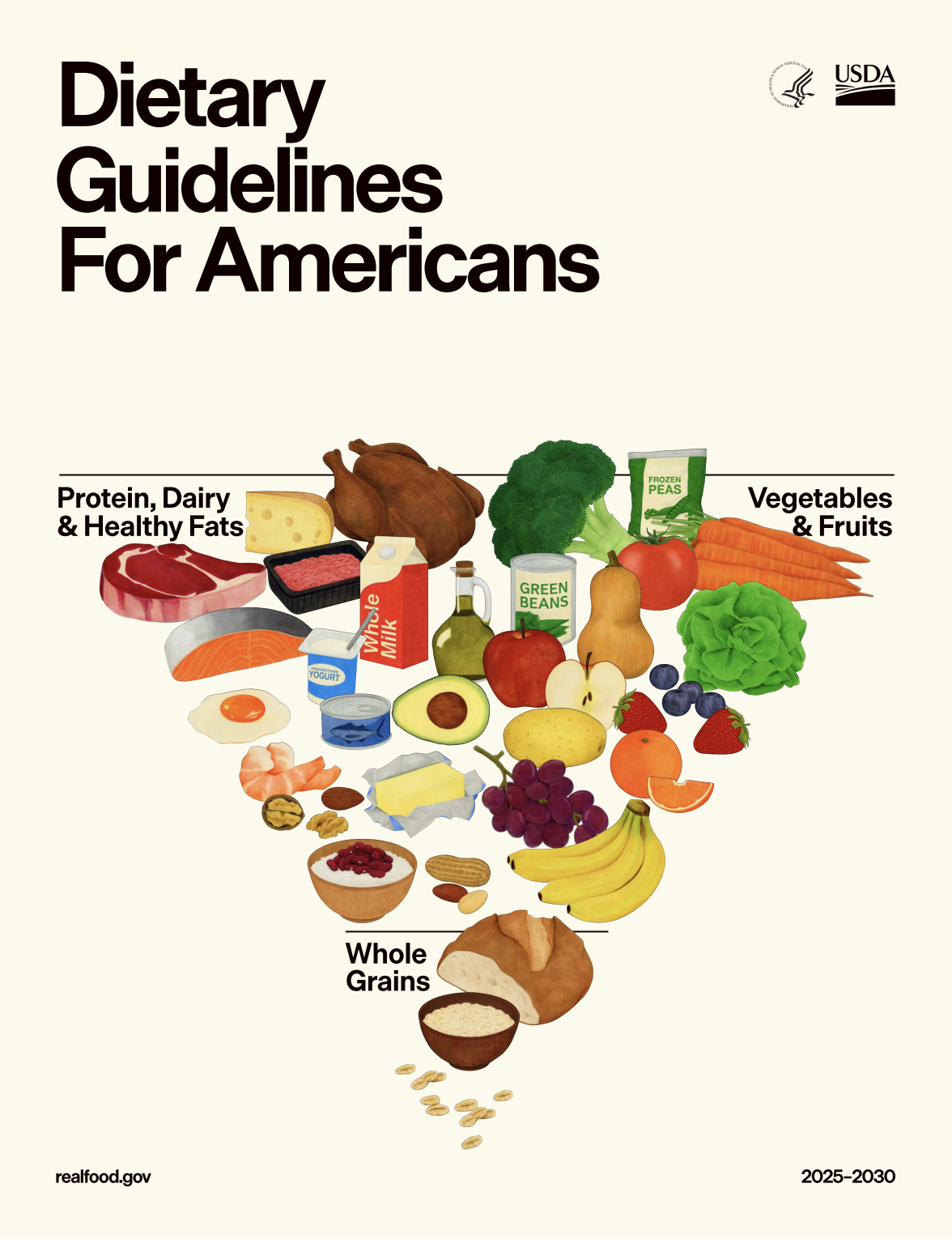
What is new is the level of attention—mostly because the government also re-introduced a food pyramid, this time flipped upside down.
Here’s an important piece many people missed:
The original U.S. food pyramid came out in 1992
It was replaced by MyPyramid in 2005 (remember the weird stairs and stick figure?)
In 2011, the pyramid was discontinued entirely and replaced with MyPlate
So this isn’t an update of the last visual tool—it’s a resurrection of an old one, with a modern twist.
Meanwhile, MyPlate—the most recent visual guide—quietly did its job for over a decade, emphasizing:
Half the plate fruits and vegetables
Balanced protein and carbohydrates
Dairy on the side
Most people didn’t even realize it existed.
A Big Shift: From 164 Pages to 10
Here’s something we genuinely appreciate: The new guidelines are only 10 pages long.
The previous version clocked in at 164 pages. Even nutrition professionals had to power through it. This time, every American can realistically read the whole thing.
That accessibility matters.
But it also comes with tradeoffs—brevity means broader language, fewer examples, and less nuance.
So while this document is easier to read, it also leaves more room for interpretation (and misinterpretation).
The New Food Pyramid: What It Shows—and What It Misses
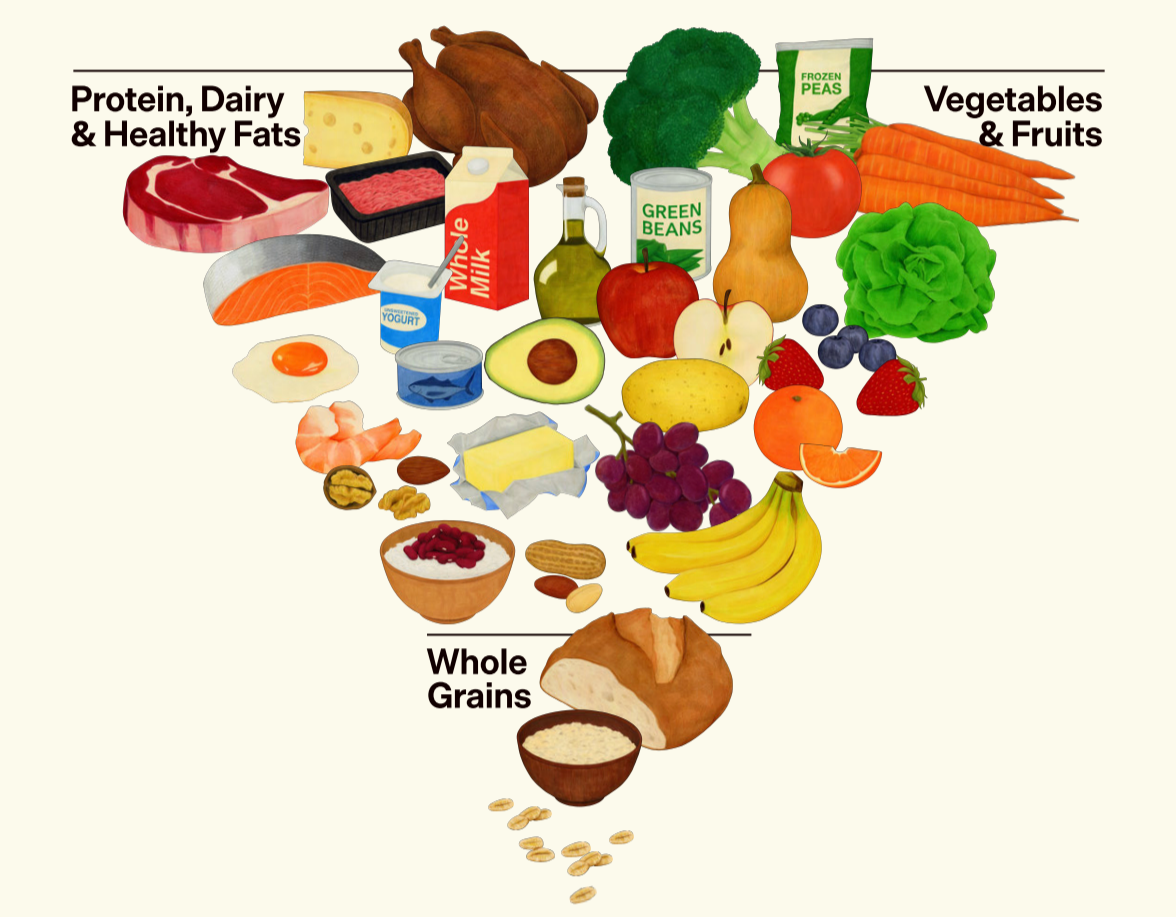
Visually, the new pyramid is inverted:
Protein and dairy are featured in the upper left
Fruits and vegetables sit in the upper right
Whole grains appear at the very bottom—tiny and easy to overlook
Here’s where things get confusing.
In the written guidelines, whole grains are actually recommended at 2–4 servings per day, which is more than any other food group. But visually? They look like an afterthought.
This mismatch matters, because most people interact with the image, not the text.
If visuals are meant to guide behavior, they need to align with the recommendations—and here, they don’t.
What the Guidelines Get Right
Let’s start with the wins—because there are several.
1. Protein at Every Meal (Finally, With Numbers)
For the first time, the guidelines include a clear protein target: 1.2–1.6 grams per kilogram of body weight per day
That’s a big deal.
The old standard—0.8g/kg—was never meant to be a goal. It was the minimum to avoid nitrogen deficiency. This new range better reflects what we see in the research and in practice.
They also emphasize:
Protein at every meal
Both animal and plant protein sources
That’s a strong step forward.
2. Fruits & Vegetables, All Day Long
This remains a cornerstone—and rightly so.
The recommendation:
3 servings of vegetables
2 servings of fruit
Spread throughout the day, including snacks and breakfast
We love the continued emphasis on:
Variety
Color
Fresh, frozen and canned
Flavoring with herbs and spices (because food should taste good)
This is consistent, evidence-based, and practical.
3. Limiting Ultra-Processed Foods
There’s clear language encouraging Americans to:
Significantly reduce highly processed foods
Limit added sugars and refined carbohydrates
This message hasn’t changed much—but it does matter that it’s repeated clearly and plainly.
Where Things Get Messy
Now let’s talk about the tension points.
1. “Healthy Fats” vs. Saturated Fat Limits
The guidelines encourage foods rich in “healthy fats,” including:
Full-fat dairy
Meat and poultry
Butter and beef tallow
At the same time, they maintain the long-standing recommendation that saturated fat should stay below 10% of total calories.
Here’s the problem: You can’t realistically do both.
Increasing full-fat dairy and animal fats without raising saturated fat intake isn’t practical. If the science truly supported higher saturated fat intake, the threshold would have changed. It didn’t.
This creates a disconnect between ideology and evidence—and leaves consumers confused.
2. Whole Grains: Written Priority, Visual Afterthought
As we mentioned earlier, whole grains are:
The highest recommended food group by servings
Visually minimized in the pyramid
This sends mixed messages and risks reinforcing the idea that grains are optional or unimportant—when the guidelines themselves say otherwise.
3. Added Sugar: Vague & Hard to Apply
One guideline suggests limiting added sugar to 10 grams per meal.
That’s difficult to contextualize and doesn’t align well with how people actually eat—especially when desserts, celebrations, and real life come into play.
We’d rather see clearer label-reading guidance or daily context than a per-meal cap that feels arbitrary.
Special Populations: A Strong, Clear Section
One area where the new format shines is in guidance for specific life stages.
We appreciate the concise, practical recommendations for:
Infants and toddlers (nutrient-dense complementary foods, early introduction of high allergen foods)
Children and adolescents (growth needs, no added sugar for younger kids, emphasis of nutrient-dense foods)
Pregnancy (including iodine emphasis)
Lactation (increased energy and nutrient needs)
Older adults (fewer calories, but equal or greater nutrient needs)
This section is easier to digest than ever—and that’s a real win for parents and caregivers.
So… Will This Fix America’s Health?
Here’s the honest truth: Dietary guidelines don’t fail because they’re wrong.
They fail because people don’t follow them.
That was true with the old food pyramid. It was true with MyPlate. And it will be true here unless behavior actually changes.
No document—10 pages or 164—can replace:
Education
Skill-building
Context
Individualized support
Guidelines set the direction. Coaching helps people walk the path.
Bottom Line
The new Dietary Guidelines for Americans are:
More accessible
Easier to read
Largely consistent with past evidence-based recommendations
They also contain:
Visual-text mismatches
Confusing fat guidance
Less nuance than previous editions
If this document gets more people thinking, talking, and engaging with their food choices—that’s a positive step.
But real change still happens the same way it always has: one meal, one habit, one person at a time.
And that’s where thoughtful, evidence-based nutrition coaching makes all the difference.
If you’d like help translating these broad guidelines into something that actually works for your life, goals, and family—we’re here to help.